

If you’ve recently found yourself questioning beliefs you’ve held your entire life, you may be going through one of the most disorienting experiences a person can face. It doesn’t have a lot of public language around it. Your friends might not understand it. Your family might be frightened by it. And you might not even have words for what’s happening inside you.
What you’re going through has a name. And you’re not alone.
The Inner Quiet Struggle
I’ve sat with a lot of people in this exact place over the past 20+ years. Some came in barely able to articulate what was wrong. They just knew something had shifted, and that the life they’d been living no longer fit the way it used to.
I think of a woman I worked with not long ago. She hadn’t set out to question anything. She was a devoted member of her faith community, a committed wife, and by most outward measures, living the life she had been taught to want. But quietly, over time, she began to notice a growing gap between what she was being taught and what she actually felt to be true in her own heart. Her core values, the things she believed about kindness, honesty, fairness, and her own worth as a person, were increasingly out of alignment with what her religion was asking of her and what she was watching it do in her community.
Then she stumbled onto information she couldn’t unknow. Historical and doctrinal details she had never been taught, things she had assumed were settled and true, that turned out to be far more complicated than she had ever been told. She brought what she’d found to her husband, hoping he could help her make sense of it. Instead, he fell into his own crisis. For him, the religion wasn’t just a belief system. It was the foundation of their marriage, their family structure, their social world, and his own identity. Her questions felt to him like the ground disappearing beneath his feet, and his panic was real.
They came to therapy not sure their marriage was going to survive it.
What I helped them do, slowly and carefully, was get underneath the fear and reactivity and find out what each of them actually valued at their core. Not what they had been told to value, but what genuinely felt nourishing, true, and life-giving to each of them as individuals. From that foundation, they were able to begin building a shared life that had room for both of their evolving experiences. It wasn’t a quick process, and it wasn’t without real grief. But hope was not only possible, it was what they found. Both of them were eventually able to live in greater alignment with their own values while staying connected to each other.
Their story is not unusual. Faith transitions, faith expansions, and faith crises are real, recognized experiences, and the emotional and relational fallout can be significant. There is real help available, and there is genuine hope on the other side.
Three Different Experiences and Why the Distinctions Matter
Faith Crisis
A faith crisis tends to be the most acute and most disruptive of the three. This is where something breaks open. A person may encounter information, experiences, or realizations that bring them to a painful reckoning, that what they believed so deeply and leaned on so completely may not be true or real to them the way it once was. The ground shifts. What felt solid no longer does.
I’ve had clients describe this as feeling like they were losing their mind, their community, and their marriage all at the same time. That’s not an exaggeration. The grief that comes with a faith crisis is real and significant, and it often catches people completely off guard because they didn’t see it coming. One day the framework holds, and the next it doesn’t.
Faith Expansion
A faith expansion is a different kind of experience. This is where a person begins to widen or reconsider what they believe, not necessarily leaving a faith, but stretching beyond its traditional boundaries. They may incorporate new ideas, question certain doctrines, or find that their understanding of God, spirituality, or meaning has grown beyond the container they were given.
Faith expansion often feels intellectually and spiritually alive from the inside. But it can create real friction on the outside, especially in high-demand religions that promote a tight fusion of belief, identity, and community. When one person in a family or marriage begins to expand, others can experience it as a threat or a betrayal. What feels like growth to one person can feel like abandonment to another, and that gap is where a lot of relational pain lives.
Faith Transition
A faith transition is generally more gradual. This is a movement from one set of beliefs or a particular religious framework toward something different, unfolding slowly over time. A person may quietly begin to shift their beliefs, their practice, or their relationship to a religious community, sometimes without fully realizing it’s happening until they’re already somewhere new.
Faith transitions can feel less dramatic than a crisis, but the relational and identity implications are just as significant. By the time many people seek therapy around a faith transition, they’ve been quietly carrying it alone for a long time.
Why It’s So Painful: The Relational Piece
For people raised in organized religions with a defined canon, clear tenets, and strong cultural norms, faith is rarely just personal. It’s relational. It’s woven into marriages, family systems, friendships, and entire communities.
When your beliefs begin to shift, it doesn’t just affect your inner world. It ripples outward into every relationship connected to that shared belief system.
Many religious communities, particularly high-demand or more orthodox ones, operate within a framework that is binary: right and wrong, faithful and faithless, righteous and lost. These frameworks can generate real fear in those who remain inside them when someone they love begins to move outside the boundaries. That fear drives reactivity, and reactivity damages relationships.
What this looks like in real life is painful. I’ve worked with couples where one spouse’s faith transition felt to the other like the floor had dropped out from under the marriage. Parents grieve. Extended family members pull away or apply pressure. The person in transition often finds themselves caught between their own emerging sense of truth and the weight of relationships that suddenly feel conditional.
This is why faith transitions so frequently show up in a therapist’s office not just as a spiritual issue, but as a relationship crisis, a marriage crisis, and sometimes a grief process unlike anything the person has previously experienced.
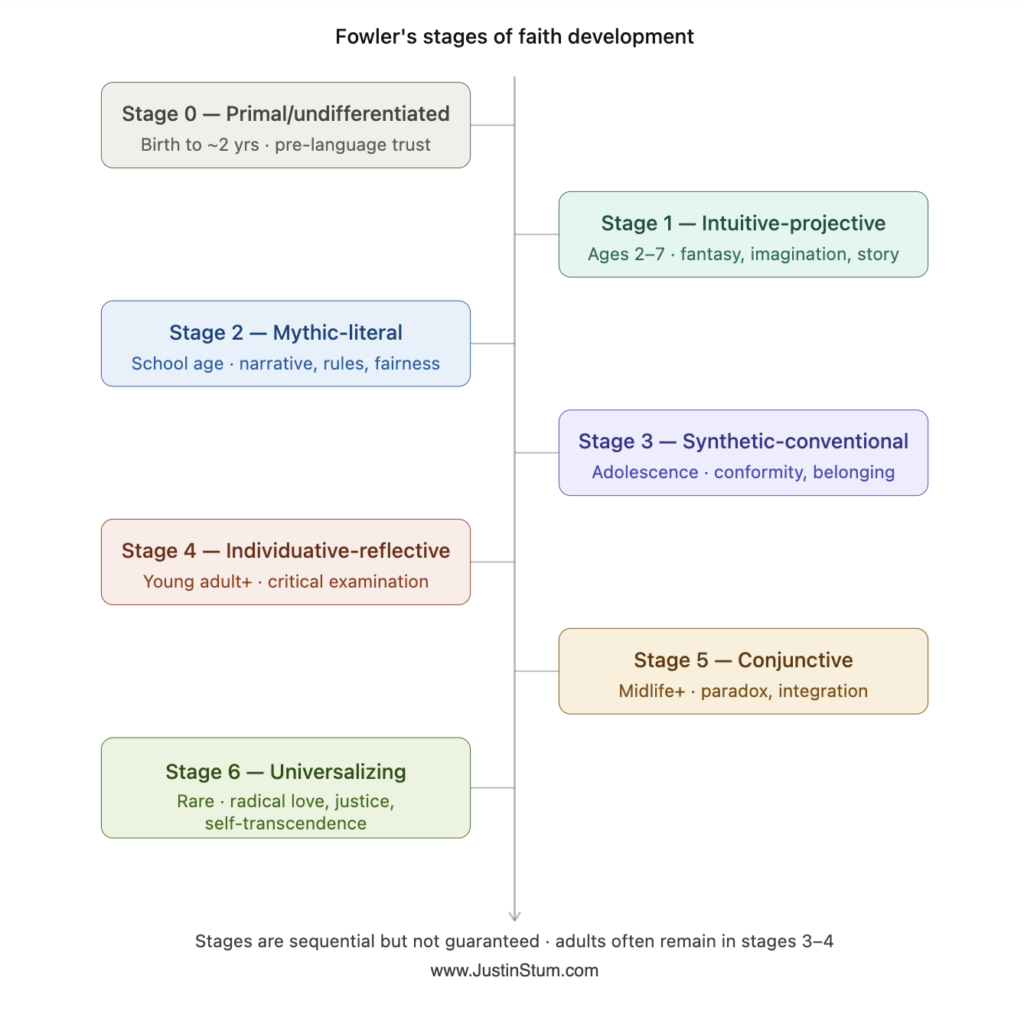
There Is a Map: Fowler’s Stages of Faith
One of the most helpful things I offer clients in this territory is the reassurance that this experience has been studied, named, and mapped.
James Fowler’s Stages of Faith is a well-researched developmental model describing how human beings move through different ways of understanding faith and meaning across a lifetime. Fowler’s work establishes that movement through faith stages is a normal part of human development, not a spiritual failure.
What many people don’t realize is that growth often requires disruption. Moving from one stage of faith to the next frequently involves a period of questioning, discomfort, and letting go of frameworks that no longer fit. That process can feel like falling apart. According to Fowler’s model, it’s actually a sign of development.
I’ve seen this play out many times. People come in feeling broken and leave with a framework for understanding their own experience that actually gives them some ground to stand on. Having a map doesn’t make the journey painless, but it makes it less terrifying.
What Therapy Can Offer and What It Can’t
I want to be clear about something: it is not a therapist’s role to tell you what to believe. That boundary matters, and I hold it carefully.
What therapy can offer is a space to slow down, get honest, and sort through what’s actually happening, without judgment and without an agenda.
Together, we look at what beliefs and practices have been nourishing, what has genuinely fed your sense of self, your wellbeing, and your relationships. We look at what is no longer serving you, what has created shame, fear, or chronic anxiety rather than growth. And we work to clarify your core values, what you actually believe about what matters, how you want to live, and who you want to be, separate from what you were told to believe.
That process belongs entirely to you. It moves at your pace. And in my experience, people who do this work come out the other side with a clearer, more grounded sense of themselves than they had before.
For couples and families navigating this together, therapy can also provide a space for conversations that are too charged to have at home, where fear and love are all tangled up and nobody knows how to talk without someone getting hurt.
There Is Hope – You Can Get Support
If you are in the middle of a faith crisis, a faith expansion, or a faith transition right now, hear this clearly: what you are experiencing is real, it is hard, and it is not the end of the story.
Many people who have walked this road describe eventually arriving at a relationship to faith, meaning, and spirituality that feels more honest and more genuinely their own than what they had before. That doesn’t minimize the loss. But it does mean there is something worth moving toward on the other side.
You don’t have to figure this out alone. Reaching out to a therapist who understands this territory can make an enormous difference, not to tell you what to believe, but to help you find your own footing again.
If any of this resonates, I’d encourage you to reach out. That first conversation is often where the relief begins.
If You’re in Utah, Nevada, or Idaho and Wondering If Life Transition Counseling Is For You
About the author: Justin Stum, LMFT, is the clinical director and owner at Elevated Counseling & Wellness in St. George, Utah. He’s been working for over two decades working with couples, individuals, and families navigating relationship distress, trauma, betrayal, and life transitions. He has a team of therapists trained in multiple modalities and will support you. To learn more or schedule a consultation, visit www.elevatedcw.com.
If you’re ready to start, or just want to ask some questions first, reach out here. We’re based in St. George and licensed across Utah, Nevada, and Idaho.